
Website selection used to be an SEO shortcut. For years, founders would brainstorm a commercial query. Modify it with a location or product modifier. Register the closest available word sequence. Then rely on the URL itself to produce a lift. That process birthed names like BestBudgetLaptopsOnline. com, DallasRoofRepairExperts. com, and BuyOrganicSupplementsNow. com.
These domains are descriptive but also inflexible. They telegraph a narrow offering. Require more characters than people want to remember. And often sound like temporary landing pages, not permanent businesses.
Both search engines and customers have evolved past that older mindset. SEO features page content, entity recognition, topical depth, and perceived user intent. Customers encounter more branded names than they used ten years ago. Moving between websites, apps, social feeds, marketplaces, and emails. On that stage, domains represent more than ASCII characters. To users and search engines, a domain is the primary namespace of a business.
Domains live inside URLs, email addresses, analytics tools, ad campaigns, browser tabs, password managers, support requests, invoices, and every link shared by an existing user. Because of that exposure, brandable domains are steadily gaining value.
Instead of describing services at the homepage level, the domain captures the entire business with enough abstraction to fit every product. It’s short enough to recognize quickly. Unique enough to avoid confusion. Pronounceable enough to spread by word-of-mouth. Flexible enough to survive a pivot. And short enough to fit across a complete digital stack without overflowing conversations or interface elements.
The DNS Isn’t Shrinking, but Popular Names Are Finite
Market conditions are not forcing founders toward brandable domains because choice is dwindling. Far from it. The domain name industry continues growing. DNIB reported 392.5 million registrations across all TLDs during Q1’26, an annual increase of 6.5 percent. The .com and .net extensions added up to 176.1 million registrations between them as of March 31, 2026.
Existing users might not appreciate how big the root domain zone has become. Hundreds of millions of choices do not seem small on paper. But new brands are not choosing domains from an open inventory. They are joining a crowded namespace.
New users aren’t just competing against registered domains. They’re competing for memorable phrases inside protocols that have been registering keywords for decades.
Registering domain names does not actually publish a website. A domain is human-readable overlay on top of the Domain Name System. DNS resolves text like Example.com into infrastructure capable of serving a website, SMTP server, API, or any other resource on public networks.
Names matter from a usability perspective because searches, redirects, keyboards, conversation recall, certificates, infrequent visitors, and error messages eventually rely on text people can read. A sixteen-character phrase with a hyphen still resolves correctly from a protocol perspective. But that does not ensure customers can remember the name. Or repeat it without friction during a podcast interview, investor meeting, mobile screenshot, or informal sales call.
Memorable branding is difficult to automate. That explains the consistent value of short, pronounceable, lexical words. The scarcity does not apply only to dictionary words. Invented words, common compounds, and abbreviated phrases face similar constraints when a market matures.
Exact Match Domains Optimized for Google Instead of Users
An exact-match domain, or EMD, usually includes a keyword phrase that closely matches a commercial target. CheapCarInsurance.com, NewYorkOfficeCleaning.com, and OnlineTaxCalculator.com are some obvious examples. Search engines did provide obvious benefits in the website’s early commercial stages:
* The domain explained the offer, upfront.
* Anchor text included a keyword naturally when people shared the link.
* Users were less experienced with judging unknown websites.
Keyword brands are not useless. Reserved-category domains remain strong assets when they’re concise, credible, and coupled with an operating business. Insurance.com is not comparable to BestCheapInsuranceQuotesOnlineNow.com. One conveys category meaning. The other is little more than a string of search terms. Both might perform well for [insurance online], but businesses demand more nuance than search phrases alone.
When startups begin with that type of exact-match anchor, they’re making an engineering decision as much as a product statement. The domain is optimized around assumptions about a target search phrase. That singular focus can become technical debt down the road.
New products get added. Companies enter international markets or pivot to B2B. Service businesses digitize their operations, or software companies introduce physical goods. At that point, a tightly branded domain can grow equally tight around the business. Either hold onto a name that no longer describes the product. Or incur widespread customer pain to migrate servers, digital assets, and reputation to a new domain.
Google has stated keyword anchors do not help TLD extension .shop recognize ecommerce websites. Nor do domains contain ranking factors, explicitly. Exact match domains remain useful in certain scenarios. But website owners should recognize when a naming strategy overly relies on specific SEO assumptions.
By shifting emphasis towards a brandable root, companies can build relevance elsewhere. Information architecture replaces much of the semantic value formerly captured by keywords in the domain name. Product pages, landing pages, internal links, structured data (where available), product taxonomy, editorial mentions, digital PR, and a consistent entity signal now define what search engines “know” about a business.
Brandable Domains Carry Extraweight in the Digital World
Some entrepreneurs misuse the phrase brandable domain. Not every invented word creates brand strength. Random strings could also be available, for example, but still feel commercially weak. Brandable is more operational: Can a business apply value-adding identity around the name?
Identity matters. Returning customers hear a domain once, then seek out their browser history, bookmarks, or verbal notes to find the URL again. This seemingly simple task requires the brain to:
1. Parse spoken language into its component words.
2. Remember each string in sequence.
3. Recall whether a hyphen or number was present.
4. Guess the domain extension.
5. Spell every component correctly before hitting send.
Each action creates potential failure points. Length and complexity increase the cognitive burden of recalling a URL by voice or muscle memory. This is why short words with common phonetic patterns tend to perform better than complex descriptors in actual business use. Just like brandable domains reduce cognitive load, leaving extra bandwidth for differentiating a company through marketing, products, and customer experience.
The same logic applies inside web architecture. Compounds supports basic sections like /pricing, /enterprise, /developers, /partners, and /resources without contradicting the brand. Subdomains like app.example.com, docs.example.com, status.example.com, and api.example.com are also common.
Exact match domains would support these records without issue. But if a startup begins with Etsy-level specificity, the naming convention begins to sound contrived when the company launches a /partners area, or introduces software.
Forward-thinking organizations should approach domains as foundational infrastructure. The name selected today often secures public-facing websites, transactional email accounts, customer logins, API authentication, product documentation, HTTPS certificates, and Twitter replies. Buying or migrating that infrastructure later is possible. But for most brands, doing so after years of accumulating dependences is costly.
Descriptive Domains Describe One Moment in Time
Descriptive domains are perfectly understandable on a first impression. But memorable names persist when comprehension fades.
From SEO queries to podcast interviews, startup customers encounter brands across multiple paths. They discover a business through a Google search. Return months later through branded search. Click on an email link. Enter the URL directly. See a social post. Or ask a friend for a recommendation over private messenger.
The first interaction usually rewards relevance above all else. But repeat visits come from recognition. Brandable domains win at recognition. They form a mental shortcut that grows associations with repeated exposure.
Successful brands often resemble Shopify more than BestWesternHotelRoomsOnline. com. Both communicate a commercial idea. But Shopify feels intentional without explaining only one element of commerce. That versatility allowed the company to grow its product offerings beyond a single definition. From payments to hardware, enterprise commerce continues fitting cleanly under the Shopify umbrella.
Stripe, Slack, Canva, Zillow, and Zoom represent other examples. Regardless of industry, these brands formed strong meaning around a phonetic idea. Then allowed products to fill that frame with real-world context. Instead of dictating services through their domain name, successful businesses build customer associations through product experience and third-party exposure.
Memorable words also copy better than rigid descriptions. Would someone more likely recommend Clear or ClearLedger as an accounting tool? Both domains may establish immediate comprehension. But you also risk spelling errors, memory failures, and referral decay every time a memorable name passes through human intermediaries.
Trade-offs Exist, But They’re Not “Brandable vs Exact Match”
It’s important not to oversell this concept as a generic principle. Brandable domains and exact-match domains answer different needs.
Exact-match domains clearly communicate intent to new visitors. Unpack the URL in their head and customers understand the product category, immediately. For certain use cases, that value can be appropriate.
* Narrow lead-generation websites.
* Highly specific tools with little lateral depth.
* Content projects focused on a single topic.
* Generic category assets with scale behind them.
The risk comes when a company evolves past early expectations. If founders decide to expand into adjacent categories, an EMD address suddenly feels inaccurate. It also hampers branded SEO potential. Founders are forced to grow rank-1 trig SearchVolume.io for a single phrase, instead of building a branded search ecosystem.
Brandable domains require more work upfront. Sites need to explain the offer clearly. Through homepage messaging, product copy, visual identity, titles tags, and sometimes paid ads. But after that education occurs, business names gain real flexibility. They can sprout into adjacent categories without sounding wrong. Build lifelong customers through branded search. And potentially trademark the domain as a symbol, if it’s unique enough.
Real-world brandable domains often contain elements of both. Some companies lean closer to descriptive keywords. Others push too far in the opposite direction, making names that sound intentionally opaque. But many successful businesses land near the center of this spectrum. They provide enough semantic signal to prevent confusion, but maintain distinctiveness to support branding in the long-term.
Finding a Brandable Domain That Fits Your Business
Ideation is not the first step. Before testing potential domains, business owners should codify their naming requirements internally. Document current product coverage, expected areas of expansion, geography, desired tonality, forbidden words, trademark risk appetite, extension preference, and budget.
This initial work prevents a common mistake. Falling in love with a domain name that sounds great, but doesn’t work against company requirements.
Domains are more than sequence of characters on paper. They are spoken in conversation, typed across mobile keyboards, and recalled by memory when users navigate to websites. That illustrates why character length does not capture the full story. Words also need to sound good when spoken aloud. Prioritize syllable count, pronunciation clarity, and orthographic ambiguity.
It’s possible for a seven-letter coined term to violate two or three of those guidelines. If users cannot confidently spell the name after hearing it once, then the domain will fail under phonetic attack. Human beings vary greatly in skill and personality. But at scale, those variances always punish complex, lengthy, or ambiguous names.
Conversely, a
brandable two-word compound might slightly exceed the ideal character count.
But if those words are familiar to the target audience, that domain will embed
itself deeper into memory than most coined alternatives.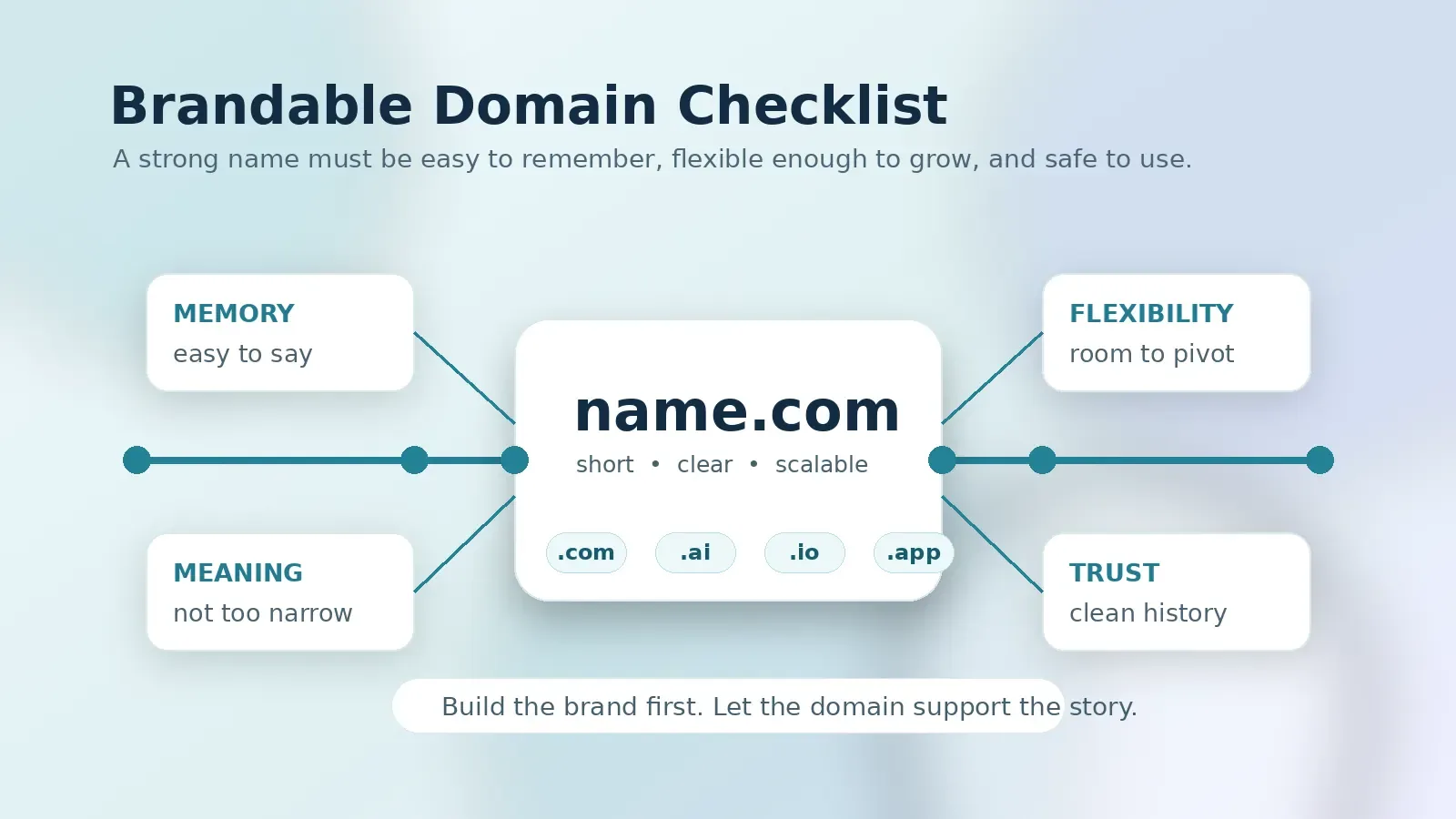
Look at successful examples before deciding on a name. Some of the best startups pronounce correctly the first time.
Criteria changes when appraising business names. Does the name follow, TasteMessage? How does it feel in lowercase? (Hint: every domain name looks weird in browser tabs and email addresses.) Are any individual words inadvertently damaged by joining two words together? Are there spelling mistakes when viewed on smartphone screens?
Use Tools to Expand Your Horizons, Not Decide for You
Brainstorming alone can uncover good names. But businesses also live in semantic space. By using a domain name generator, entrepreneurs can programmatically combine root words, merge categories, invent syllabic placeholders, and cross-reference unused extensions.
Ideation software can help founders find good names. But software cannot hold final judgment. Name generators lack empathy, meaning they do not filter outputs based on concept severity, tone, competitive meanings, or any of the subtle pressures a human founder feels when naming a business.
A strong name generation session starts with inputs. Manually compile lists for product terms, customer outcomes, emotional associations, industry jargon, metaphors, verbs, synonyms, and syllabic fragments. Only then start feeding combinations into a generation app.
Download candidate lists, then cull aggressively. The goal here is not collection hundreds of names that sound acceptable in isolation. Goal is instead to identify three to five undeniable winners with strong spoken phonetics, believable spellings, and enough thematic space to describe future products.
Your Own Domain Name Ideas List Starts Here
Any service capable of generating domain name ideas for startups will expedite this process. The suggestions listed here may trigger additional concepts not previously considered. Extensions like .io and .ai will appear below as well. Tech startups frequently use these extensions, sometimes without regard for whether they actually fit the product, audience, or industry.
But here’s the thing about outsourcing ideation to machine learning. Computers will constantly iterate upon macro suffixes (-ly, -tion, -ing), slang references, common misspellings, grammatically correct but awkward blends, and more. Filtering through bad names is still the entrepreneurs responsibility.
Don’t Sleep on .com in 2026
It also doesn’t hurt that .com registrations continue outpacing alternatives by a wide margin. DNIB observed over 161 million .com domains at the end of last year. Total growth across .com and .net has even increased into 2026’s first quarter.
That explains why most users still attempt website addresses with the .com extension by default. Younger consumers will sometimes skip directly to a TLD when typing URLs into a browser. But older customers rarely do this unless reciting a domain from memory.
This makes .com alternative trickier to recommend. High-value leewaynames often face competition from brand owners who registered the .com version years ago. An infrastructure company could benefit from using .io or .dev. Meanwhile, AI startups would struggle to find a meaningful reason against .ai.
These are signals, not mandates. GoDaddy does not grant websites a positional ranking bonus for selecting a descriptive word inside the TLD. The thought process should center upon brand fit, confusion risk, email reliability, audience expectations, and cost to acquire.
Questions should revolve around user confusion, not availability alone. If someone else owns the .com version, that risk is probably high. Otherwise, founders can estimate how many conversions they’ll lose to typos, mistyping, or confusion before deciding how much .
Where To Find Expired Business Domain Names for Sale
Buyers typically purchase domain names from two primary venues. Registrars sell unclaimed domains just like any inventory good. These are standard registration purchases that cost a recurring fee. Secondary markets facilitate live transfers between existing domain holders.
The majority of available businesses for sale fall into this second category. Short, memorable names were snapped up years or decades ago. New owners typically list domains for sale when capitalizing a brand, pivoting a business, or hedging against market risk.
Accountability comes first. Always ensure the party hosting the domain also sells it. Fraudsters do occur in this market. Then use a secured process to exchange funds, hosted by a legitimate broker.
View information about the domain at a registrar. Inbound Registration Data Access Protocol, or RDAP, is ICANN’s official source of registration data for generic TLDs. The agency replaced legacy WHOIS infrastructure with RDAP on January 28, 2025.
RDAP will not show private contacts orPersonal email addresses due to GDPR. But interested parties can verify who controls the domain today based on registrar, registration date, domain status, and listed DNSSEC records.
Owners should also dig into registration history. Archived pages, past search results, backlink trajectory, spam complaints, malware alerts, or previous brand association can all impact reputation or signal heavy remediation.
Marketplaces do exist for this purpose. Official premium marketplaces, registrar-led marketplaces, and independent brokers can all validate purchases when structured correctly. What matters is each seller can prove access to the name.
Domain acquisition should include trademark screening. Control a domain does not imply rights to use that name as a trademark. Entrepreneurs can unintentionally register domains while infringing on competitors marks.
Any startup should search national databases before paying for a domain. In the U.S., entrepreneurs can lookup terms through the USPTO trademark database. WIPO also offers a Global Brand Database for simultaneous multi-country searches.
Exact matches should raise flags. Phonetic variations matter too. So do common typos, spelling mistakes, and variants closely related to the product or service.
High-risk purchases should always consult legal counsel. Intellectual property law can be complicated, intentionally. WIPO resolved over six thousand domain-name cases in 2025 alone. 2025 marks the 25 th year WIPO has administered the UDRP process.
That backlog increased to over 80,000 total cases last year. Trivial domain decisions became trademark lawsuits. Every startup deserves the chance to prove themselves. Not every name will hold that opportunity.
Setting Up Domains for Long-Term Success
ICANN requires registration contact to renew domains. While registrants should automate this process via their registrar, founders should also prepare infrastructure around DNS. This includes deciding where DNS records will live, enabling DNSSEC where appropriate, standardizing approval cycles for new records, and recording each asset under management.
DNS inventories often go undocumented. Which exposes businesses to unnecessary risk when employees enter passwords, update records, or transit leadership. Domains used for websites should document factual website records, email addresses, DDI/DNC verification, subdomains, external APIs, and anything else referencing DNS.
Lookalike domains also demand defense. Configure SPF, DKIM, and DMARC against known email services. Then consider defensive registrations against common misspellings, whether by typo or pronunciation. Any startup collecting email addresses or selling payments might benefit from similar protections against Codyinmo .net.
Domain purchasers should record proof of ownership internally. Full registrar name, auto-renewal date, DNS provider, account contacts, payment method, locked transfer status, and domain owner should all be recorded somewhere.
Passwords and personal inboxes are memorably weak links in this chain. If employees leave, lose access to their email, or are unresponsive for weeks at a time, your domain suddenly comes into question. Prevention is much easier than post-mortem recovery.
Domains Are Labels for Businesses, Not Products
Domainers are not advocating every business toss their exact-match domains in favor of something brandable. Certain category-rooted websites serve a clear purpose. EMD brands drove SEO conversations for decades, multi-year periods when search engines mattered more than the majority of customers.
The problem is startups rarely remain stagnant. Products change, markets evolve, SEO strategies pivot, and customers find new channels every year. Companies need a name that’s built to last. One that represents where the business started, not where it was parked ten years ago.
Domains perfectly fit that definition. When chosen correctly.