
Older domains direct users to websites and other online services. Web3 domains can do that too. They provide another function: mapping a readable name to wallet addresses, decentralized content, identity records, and decentralized app profiles that are stored or referenced on a blockchain.
That’s an important distinction to understand. The domain example.com is registered through the Domain Name System, or DNS, using a registry and registrar workflow. The Web3 domain example.eth can be registered through smart contracts and resolved through blockchain-enabled applications.
The two naming systems serve separate functions, and neither automatically interoperates with the other. Blockchain domains do not replace DNS — just as most decentralized domains can’t automatically resolve inside major browsers today.
Building Blocks: Web3 Domains Explained
Web3 domains are readable names that are managed on a blockchain naming platform. Instead of passing along a difficult-to-read wallet address, you can link a readable name to one or more cryptocurrency wallets.
The Ethereum Name Service, or ENS, provides a straightforward example. According to ENS’s overview of its service, Ethereum names provide an easier alternative to computer-readable addresses, though they can link to crypto addresses and decentralized websites as well.
studio.eth might be easier to verify than a wallet address that’s 42 characters long. Shorter names can prevent typos. They’re also easier to read in chat messages, invoices, and community forums.
ENS represents one blockchain domain model. Another example that highlights key differences is Unstoppable Domains.
“Web3 domain” describes several technical approaches to blockchain-based naming. Ethereum names use an onchain registrar service and must be renewed periodically. According to ENS’s pricing documentation , five-character-plus names cost $5 in ETH per year at current exchange rates. Names do not include gas fees, which are typically higher for shorter names due to limited supply.
Unstoppable Domains Unlimited Names
Unstoppable Domains has a different business model. Its website explains that domains purchased through its platform use permanent ownership rather than renewal.
Potential buyers should study the rules of each namespace rather than assuming every Web3 domain works like an NFT you can own forever.
Which Is Growing Faster? DNS vs Web3 Names
Regardless of growth rates, Web3 domains will not replace DNS any time soon.
Compare size metrics between the DNS and Web3 ecosystem. Web.com Market Research's Domain Name Industry Brief captured 392.5 million registrations across the entirety of top-level domains as of Q1 2023.
Blockchain names don’t register or renew in the same way as typical domains. Names could be minted, wrapped, transferred, issued, renewed, or registered as subnames.
They also live on various blockchains. ENS domains live on Ethereum. Other providers work with Polygon, Solana, and additional networks.
Comparing apples to oranges doesn’t present a complete picture of either ecosystem. It’s also worth noting how each sector could grow and where Web3 names are currently used.
Unique Traits: Why People Use Blockchain Names
Blockchain domain names are mostly used to simplify cryptocurrency addresses. ENS shows how lookups can occur; user-entered names convert to Ethereum addresses that a wallet can read.
Users can share or message an ENS name instead of a difficult-to-read cryptocurrency wallet address.
Decentralized names aren’t just easier to read; crypto transactions also can’t be reversed. Sending cryptocurrency to an incorrect address results in a permanent loss. Having an easier-to-read address reduces, but doesn’t eliminate, risk. Double-check resolved addresses before confirming cryptocurrency transactions.
Blockchain domain names can hold other types of information on the blockchain as well. One blockchain address could link to multiple wallet addresses, user profile information, plain text records, and links to decentralized websites.
Blockchain domain names create an identity layer that’s portable between compatible apps and services.
The Current Barrier to Mainstream Adoption
Redirecting a Web3 domain to decentralized content doesn’t work like visiting a regular website.
The ENS documentation about decentralized websites notes that decentralized sites don’t load by default in major browsers including Chrome, Firefox, and Safari. Compatible browsers as of this writing include Brave and Opera. Extensions like MetaMask might resolve names as well.
This isn’t
limited to ENS. According to Unstoppable Domains,
decentralized websites that use its domains may resolve in browsers like Brave
and Opera but will not automatically resolve in other browsers.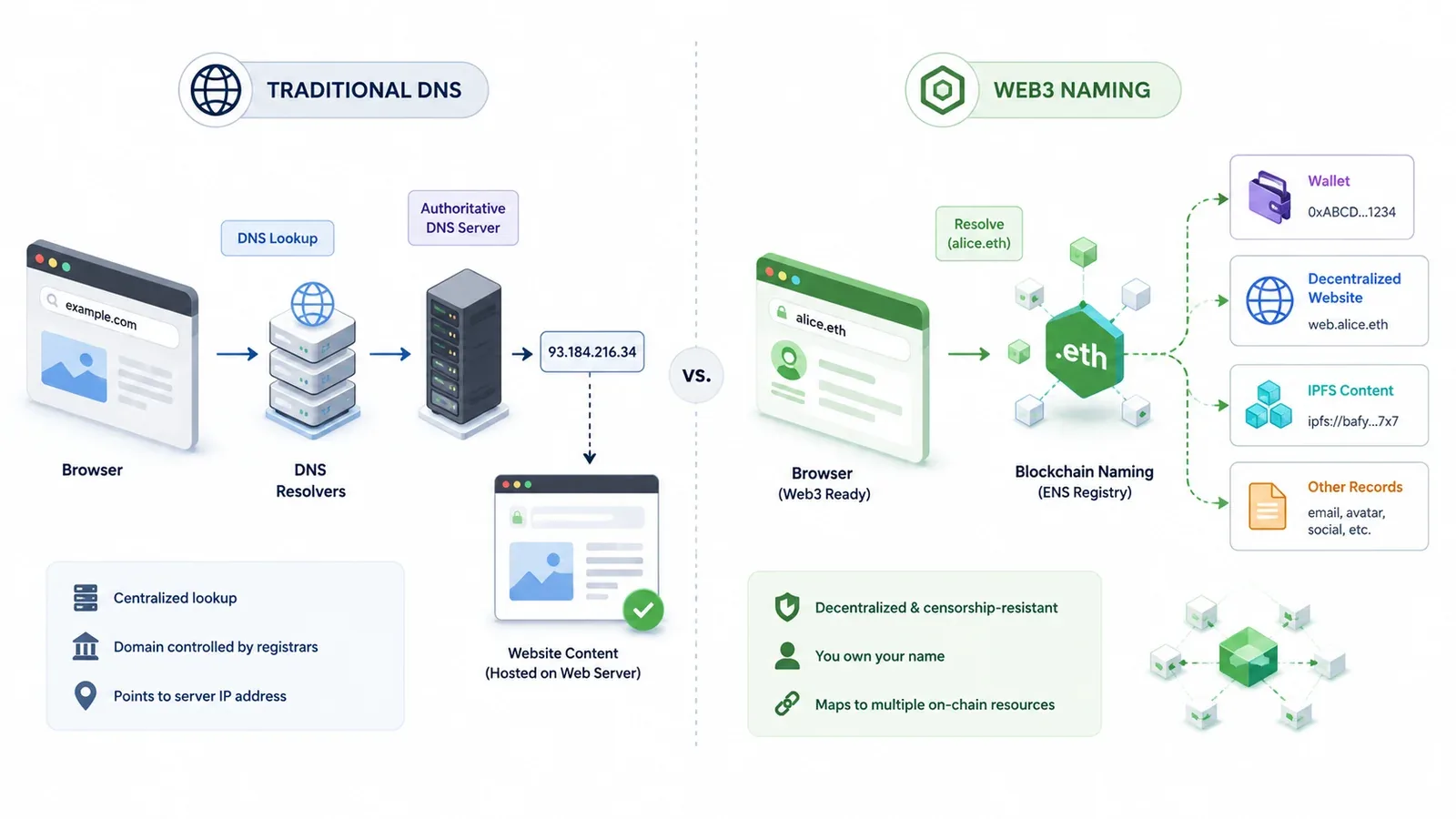
This is a notable hurdle for mainstream adoption. You can type google.com into almost any web browser and load the website. Typing google.crypto into most browsers yields different results. As of now, thatWeb3 name does not automatically redirect to google.com.
If you want visitors to access blockchain-linked content, you’ll need to use a gateway. The gateway becomes the middleman that converts HTTP requests into blockchain requests or requests for content stored on a decentralized network like IPFS.
Guidelines to Host a Website on a Blockchain Domain
IPFS defines itself as a decentralized network for storing files, websites, applications, data, and other digital assets.
IPFS uses content addressing rather than location. Content addresses are numerical values derived from the content itself. Similar to how a hash summarizes filenames or messages that are far longer, IPFS content addresses refer to uploaded files.
Once you understand how these individual components work, here’s how to use a blockchain domain to host a decentralized website:
1. Publish your
website on IPFS or compatible storage platform.
2. Retrieve the content identifier.
3. Input content hash on your blockchain domain service.
4. Confirm resolution through an supported browser or gateway service.
5. Keep a DNS record that points to an HTTP website if you need wider
compatibility.
Cloudflare offers an example of how gateways can work. Its Web3 gateway documentation explains that developers can use gateways that allow HTTP access. Using gateways means apps don’t need to run their own nodes in order to access IPFS and Ethereum.
Web3 browser support is evolving. It’s not universal.
Brave’s announcement explains that the company is building a sort of crypto DNS system complete with multiple blockchain naming providers. Compatibility is growing, but not every browser adopts these changes at the same rate — or uses the same suffixes.
Considering Namespace Collisions and Brand Strategy
Namespace collisions are another technical risk to consider. It’s possible that a blockchain naming provider issues an ending that later conflicts with another blockchain provider or DNS extension.
Ask how providers solve namespace collisions if you’re shopping for Web3 real estate as a business. How do they handle resolution precedence rules? Who controls smart contracts if the provider upgrades its technology? What happens if the owner loses custody of the smart contract?
Major browsers are adding support for Web3 domains. Until everything works inside every browser, compatibility issues will persist.
Comparing Unstoppable Domains to ENS
Unstoppable Domains and ENS solve similar problems through different solutions.
ENS domains utilize Ethereum smart contracts. They charge annual fees. The ENS ecosystem focuses on wallet identity, reverse lookup, app profiles, and decentralized websites.
Unstoppable Domains sells several blockchain-specific extensions that don’t expire. Owners can buy names outright rather than paying fees to register new names on Ethereum.
Both services work with various cryptocurrencies and wallets. Both enable smart-contract-enabled browsers to resolve their extensions. Neither service is strictly better than the other.
Developers who work with Ethereum may prefer .eth. Bitcoin owners may prefer .bit. Businesses who want a backup plan that solves universal compatibility should keep a regular domain name as their primary address.
A Few Additional Tips Before You Buy
Purchasing a Web3 domain is slightly more complex than buying a standard domain. Consider these steps before buying:
1. Understand
the difference between blockchain naming services.
2. Store your crypto wallet offline. Use a hardware wallet if possible.
3. Double-check the website before connecting your wallet. Look for copycats.
4. Don’t rush. Double check name servers, blockchain selection, and account
addresses before saving changes to your blockchain domain.
5. Keep a DNS domain name for situations that require universal compatibility.
Web3 Domains Are Useful. They’re Not a Replacement for DNS Yet.
Blockchain domains serve a real purpose. They make crypto addresses easier to read and share. Identity information can be portable across apps that read the same naming service. Web3 domains can link to decentralized websites.
Web3 domains aren’t suitable for every situation. They introduce unique custody and technical considerations. Not every Web3 domain resolves in every browser.
Consider blockchain names where they solve a problem. Continue using DNS when everyone needs to find your organization online.