
For much of the commercial internet’s history, the first rule of choosing a startup name was the same as the second and third: get your .com first, then build your company name around whatever .com happens to be available. For most startups, that practice still makes sense. Over time, however, it’s losing its dominance. According to recent research from Identity Digital covering over 4,000 startups launched by Y Combinator and Techstars, 54 percent of startups created between 2020 and H1 2025 used nontraditional domain extensions for their primary domain as of June 20th, 2025.
Time was when it seemed impossible for startups to avoid .com. Nowadays it’s increasingly acceptable not to use it. This doesn’t mean .com domains have suddenly become scarce. When available, they still offer strong branding benefits. Businesses choosing other extensions are not swinging wildly — they are simply picking a shorter name that matches their company name without the extra words, misspellings, and stuck-on verbs required to dodge taken .coms.
Startup Domain Trends Are Changing Fast
Two big takeaways from the Identity Digital study stand out. First, startup domain trends for 2026 are moving quickly. During the five years ending in June 20th, 2025, startups in the research sample increased their usage of nontraditional TLDs by 50 percent. Meanwhile, “legacy” extension use fell by 28 percent inside the same pool of startups.
Second, adoption rates inside Y Combinator and Techstars are already high. Albeit from a community of companies that may have more flexibility than most, startups launching with .io, .ai, or other extensions are rapidly approaching 60 percent. “Founders have long accepted second options like .io and .tech within accelerator programs,” the researchers said. “[…] Now it seems they may be entering the mainstream.”
Customers Know It Too
Startup websites used to have to explain their chosen extension. Many no longer do. Because so many brands use domain endings like .ai, .io, .tech, and .global, customers have become accustomed to what these words imply about a business. An extension can now be part of your brand name, rather than an unavoidable detail slapped on the end of it.
For example, people expect startups to use extensions that match their industry. For instance, .io doubled as a generic tech term for years before cloud companies adopted it in force. Identity Digital also found startups were 44 percent more likely to choose an exact brand match if they picked an extension outside of .com. Customers now recognize enough of these names that they can blend into a full company name.
Variations Exist Within .com
These brands do not sound like .coms. In fact, exact brand match rates inside .com fell to just 54 percent in the study. Compare that to 85 percent among users of “alternative” extensions. When founders can’t get the domain they want, they used to compromise with yournameisnottaken.com. These days they’re more likely to pick an extension that fits instead.
Freed from .com monopoly, startups are forcing competitors to accept branding priorities outside of “use whatever name is left” mode. Yes, businesses can still add an arbitrary verb to preserve using .com. Identity Digital noted a 67 percent increase in the use of verbs at the second level over the same five-year period. Getbluebook.com, tryoperand.com, and others certainly sound intentional—but not every company wants its primary domain to feel like a compromise.
.ai Leads the Way Into 2026
One extension leading the change is .ai. Originally the country code top level domain for Anguilla, these two letters have been repurposed as shorthand for artificial intelligence. Identity Digital found .ai usage among the startups in its dataset tripled between 2020 and June 20th.
.ai may excel
among startups now, but it’s gaining registration traction across the entire
domain industry. Domain Name Wire reported earlier this month that .ai
passed the one million registered domain mark in January. By July that
number should climb above 1.2 million. Domain names are products people
buy. Extensions that double as marketing keywords can reach these
milestones faster.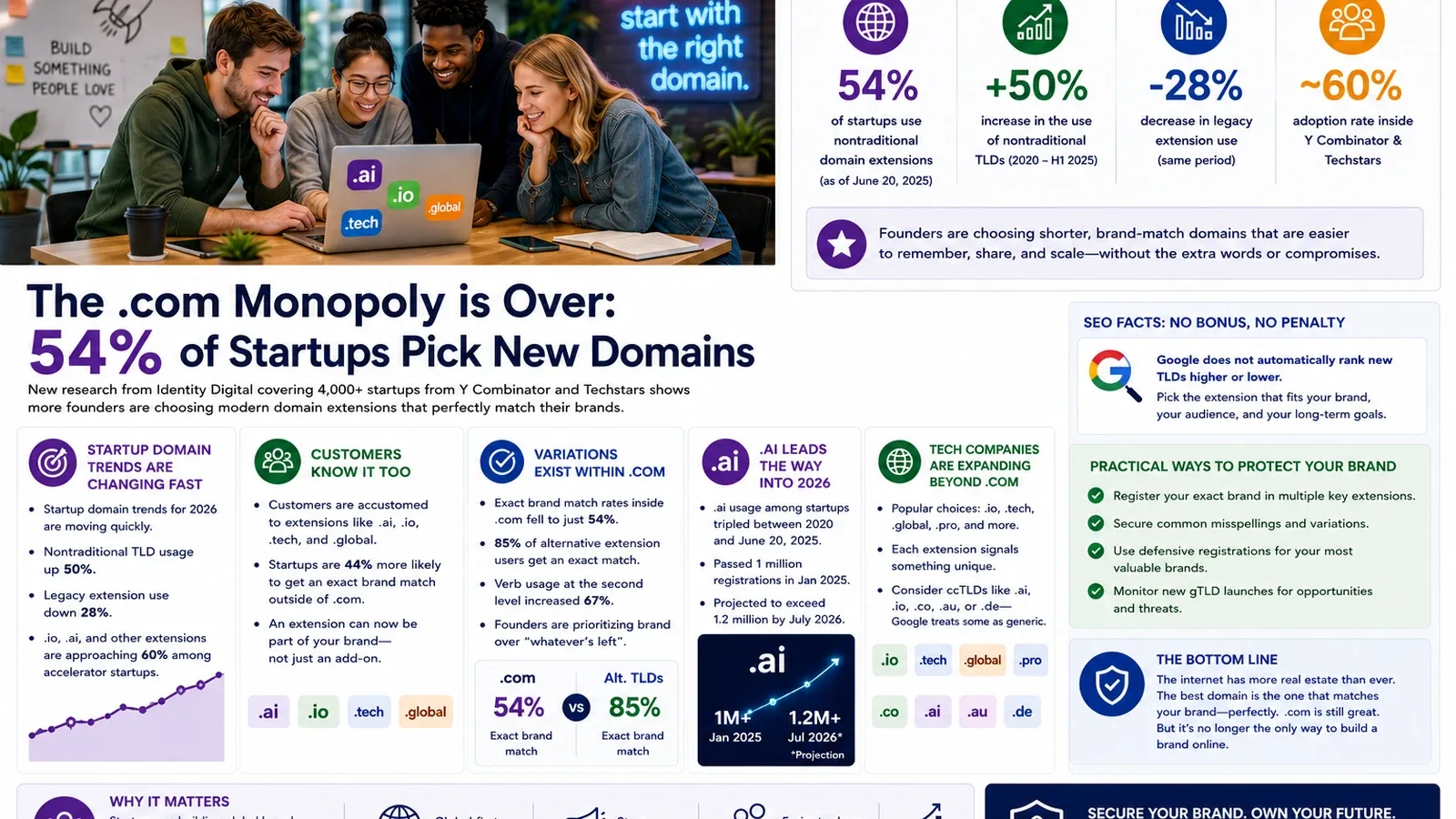
Tech Companies Are Splitting Other Extensions
.ai may lead the way into 2026, but it’s far from the only major extension seeing rapid adoption. Devs have long used .io as a supplement to .com. Startup companies routinely choose .tech to signal their category before a visitor clicks through to their website. Consulting businesses and freelancers with international clients often prefer .global or .pro.
Each option signals something unique about your company. If one fits your brand better than others, go for it. In some cases founders may find .gov, .edu, or another ccTLD more suitable for their audience. Google lists seven ccTLDs it also treats as generic for search purposes, including .ai and .io. Those that choose less common ccTLDs should expect those names to perform well internationally.
Google Won’t Bonus or Penalize New gTLDs
Speaking of search engines, it bears repeating that modern extensions do not automatically rank better or worse in search results. Google comments on the topic from time to time, but this advice has been true since the early days of new gTLDs. Pick an extension with a built-in keyword at your own risk. Unless Google says otherwise, treat new extensions as you would .com or .net.
Realistically, a memorable domain has several advantages over a weak alternative. Relevant keywords build recognition and can help people remember a new service. That alone can lead to better search performance, especially when paired with an otherwise strong website. On the other hand, an unusual extension can turn away customers who fail to understand it or do not trust a technology brand with a local addressing scheme.
Have a Second .com (Just In Case)
Your first domain does not have to be the final piece of your defensive registration portfolio. Instead, startups can launch with a shorter, more brandable domain then monitor the .com for a year or two. If prices eventually drop, many startups elect to acquire their matching .com and point it at their main website. If not, they can renew it to keep competitors from squatting.
Whatever users eventually type into their browser won’t change. As long as your startup owns the correct social handles and your primary website offers a clear path to purchase, it hardly matters whether a visitor comes from www.example.com or example.ai. But buying a direct competitor’s address years after launching can be expensive. Monitoring lets founders know when the time is right.
Building a Startup Domain Strategy
Start with your spoken brand test. If someone you ask cannot spell or remember the domain name you’re considering, your extension will not fix that. Next, review availability across .com and all the extensions mentioned above—or any country code TLD your customers already recognize. Trademarks and social handles should be reviewed at this stage too. Businesses often sabotage their online branding by failing to secure basic elements like @example on Twitter.
Look into renewal prices before committing. A few cents on renewal matter little for inexpensive TLDs, but renewal fees for premium domains can exceed $100 per year. Discount domains registered through promo codes sometimes gain different pricing tiers as well. Once registered, ensure your business has ownership of the primary domain, common misspellings, and any obvious typosquatting attempts. Beyond that, let customers guide your growth.
Lastly, lay out a three-year domain plan. Some domains can be sold if the business pivots. Others should be kept off limits indefinitely. Understanding which names you can safely monitor and which you should renew every year allows founders to identify opportunities to acquire their .com down the road.
It’s not that .com domains are suddenly hard to register. It’s that today’s alternatives give startups enough credibility that they do not have to bend their brand name to fit a leftover address. As more startups launch with .io, .tech, .global, and the like, expect that statistic to climb even higher. (Just remember the data above only applies to Identity Digital’s research set of 4,000+ startups. Not every startup worldwide.)